You order food when you are hungry. You order food when you are not even that hungry but the idea of cooking feels like a personal insult. Either way, the moment you tap "Place Order", something strange happens. You stop being a normal person and become a detective, a philosopher, a weather expert, and a hostage negotiator — all while staring at a tiny bike icon on a map.
Scientists have not studied this. But anyone who has ever ordered biryani at 9 PM knows the truth: waiting for food delivery is a full emotional journey. Here are the seven stages, in order.
Stage 1: The Confidence
You have placed the order. The restaurant has confirmed it. The app says "Preparing your order" and gives you a cheerful estimated time: 35 minutes.
Thirty-five minutes. Easy. You have waited longer for a bus that never came. You put your phone down like a calm, mature adult. You decide to be productive while you wait. You will drink some water. You will maybe read something. You are in control.
This stage lasts about forty seconds.
Stage 2: The First Check
You pick the phone up again. Just to confirm the order went through. It did. The status has not changed. It has been two minutes.
You lock the phone. You unlock the phone. You open the app again. Still "Preparing". You refresh by pulling down, even though the app refreshes itself. You are not worried. You are just... checking. A responsible customer checks.
Somewhere in the kitchen, a chef is doing their job. You do not know this chef. You are now emotionally invested in their speed.
Stage 3: The Map Staring
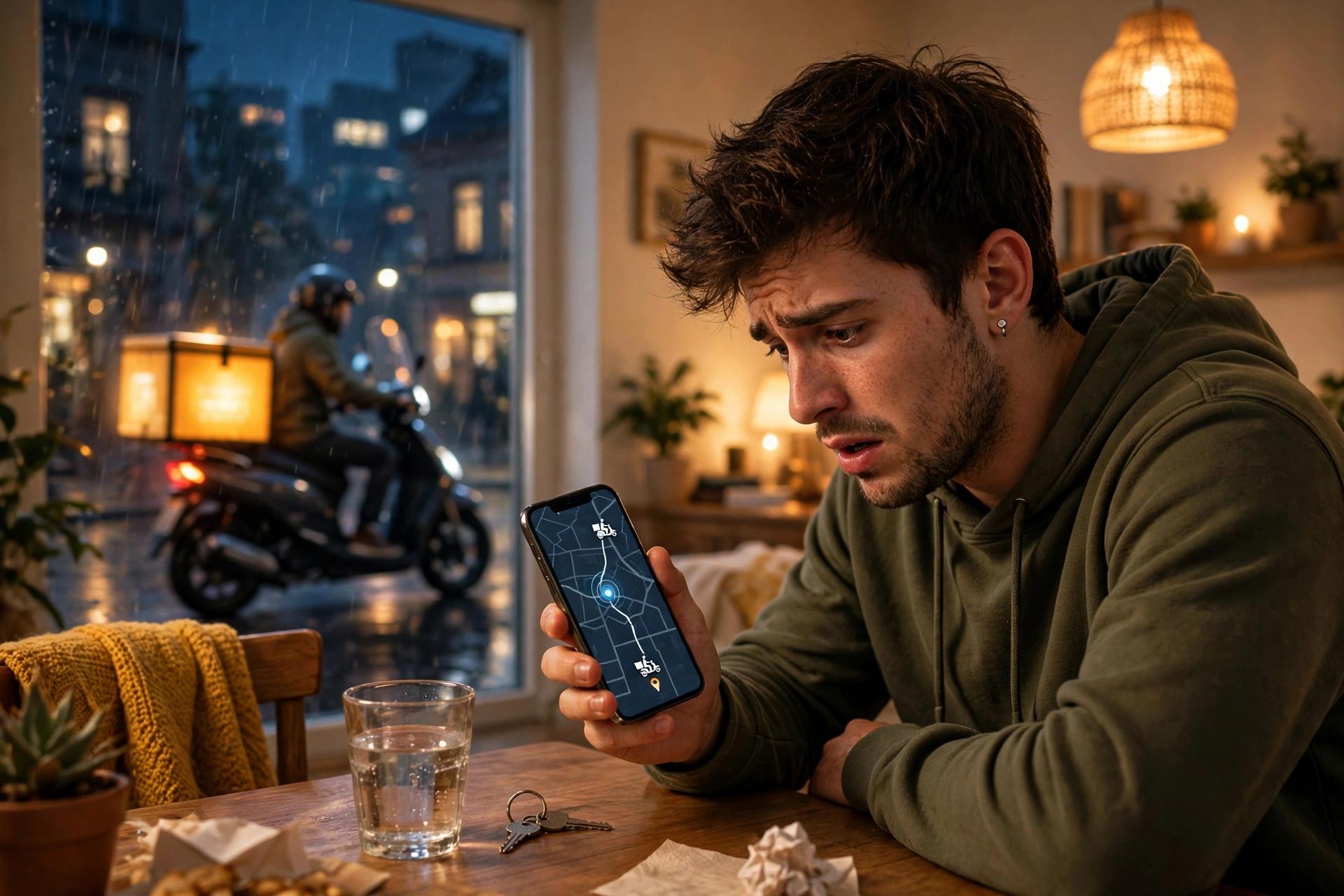
Then it happens. The rider is on the way. A little bike icon appears on the map, and suddenly your evening has a purpose.
You watch the icon move. It moves one street. Then it stops. Why did it stop? Is there traffic? Did the rider forget something? Is my food getting cold at a red light right now?
You zoom in. You zoom out. You switch to satellite view for no reason. You now know the names of streets you have never visited. You could probably draw the rider's route from memory.
The estimated time says 12 minutes. You decide the app is lying. Or maybe it is telling the truth and you simply cannot accept that 12 minutes is a real amount of time that humans have survived before.
You text your friend: "bhai khana aa raha hai." Your friend replies: "ok." This conversation was necessary.
Stage 4: The Hunger Multiplication
Here is a law of nature nobody talks about: hunger grows faster while food is on the way. Before ordering, you were mildly hungry. Now that food exists somewhere in the world and is travelling toward you, your stomach has filed a formal complaint.
You open the fridge. Nothing. You open the cupboard. A packet of biscuits from last month. You eat one biscuit, which is a mistake, because now you are somehow hungrier than before. Science cannot explain this. The biscuit was supposed to help. It betrayed you.
You consider making tea. Making tea would take ten minutes, and the food might arrive in ten minutes, and then you would have tea AND food, which sounds perfect, but what if the rider calls while the kettle is boiling? You cannot risk it. You sit back down. You drink water. Water is not food. You knew that already, but it is worth repeating.
Stage 5: The Phone Call Panic
The rider calls. Your heart jumps. This is it. This is the moment.
"Hello, bhai, main neeche khara hoon."
You were not ready. You are never ready, even though you have been ready for twenty-five minutes. You grab your keys. You check your wallet. You run downstairs like the building is on fire, except the building is fine and the only emergency is a bag of food.
Or worse — the rider calls and says, "Bhai, location samajh nahi aa rahi." And now you are giving directions to your own home like a tour guide: "Seedha aayen, phir right, woh jo green gate hai, uske saamne..." You have lived here for years and suddenly you cannot describe where you live. You consider sending your live location. You send it. It says the rider is 200 metres away. He is not 200 metres away. The map is lying again, or the GPS is confused, or the universe is testing you.
Stage 6: The Doorbell
The doorbell rings. Or a knock. Or the rider's voice from downstairs. Time stops.
You open the door. There it is. A warm bag. The smell hits you before you even take it. This is the greatest moment of your day, and you know it, and you do not care.
You say thank you. You mean it. The rider has travelled through traffic, rain, heat, or cold so that you could eat without leaving your chair. If there is a tip option in the app, this is the moment to use it. The rider deserves it. You know it. Do it.
Stage 7: The First Bite Peace
You sit down. You open the box. Steam rises. You take the first bite.
Silence. Peace. All is forgiven. The waiting, the map-staring, the biscuit betrayal — all of it was worth it. Your phone, which you checked forty-seven times, is now face down on the table, forgotten. You are a calm, mature adult again.
You finish eating. You feel full, happy, and slightly sleepy. You think to yourself: next time, I will be patient. Next time, I will not stare at the map. Next time, I will just relax and wait like a normal person.
Next time, you will do exactly the same thing again. And that is fine. That is the deal we all signed when we discovered we could summon food to our door with a phone. The waiting is part of the meal. The rider is the hero. And the first bite is the reward.
So the next time you catch yourself refreshing the tracking screen for the ninth time in three minutes, do not feel embarrassed. You are not impatient. You are simply a person who loves food and has somewhere to be — at the table, with a warm plate, exactly on time.
The honest truth
Food delivery is a small everyday miracle: someone cooks, someone rides, and dinner appears at your door. The waiting feels long because hunger makes every minute louder. So order a little earlier, keep some water nearby, tip your rider when you can, and remember — the food is coming. It always is.